
Do all PU wood coatings need diisocyanate training?
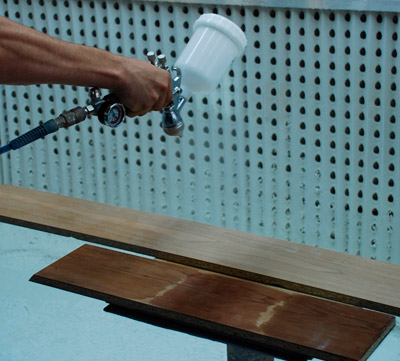
No — but the answer depends on the specific product, and more people than expect it are getting it wrong in both directions.
Since 24 August 2023, anyone using diisocyanate products industrially or professionally in Great Britain has had to complete approved training first. Some finishing shops have assumed it catches everything they spray. Others have assumed it does not apply to them at all. Both are guessing, and the answer is written down.
What does the rule actually say?
The requirement sits in entry 74 of Annex XVII to REACH. It says diisocyanates may not be used as substances, as a constituent of other substances, or in mixtures for industrial or professional use unless one of two things is true: either the concentration of diisocyanates individually and in combination is less than 0.1% by weight, or the users have successfully completed training on safe use before they start.
So it is not a ban and it is not universal. It is a threshold, and either you are under it or you have trained your people.
Two details worth holding on to. The figure is total monomeric diisocyanate — individually and in combination, so several small amounts add up. And it is less than 0.1%, not up to 0.1%, so a product sitting at exactly 0.1% does not qualify for the exemption.
Which part of the product carries it?
In a 2K wood coating, the diisocyanate is in the hardener. The lacquer itself does not contain it.
That means the question is answered by the hardener you use, not by the lacquer. If your hardener falls below the threshold, the system it is used with does not trigger the training requirement either. If your hardener is above it, training is required regardless of which lacquer it goes into.
It also means that changing hardener — for a faster cure, a different pot life, a particular finish — can change your position without anything else about the job changing at all.
How do you find out where your product sits?
Three places on the safety data sheet, and it takes a couple of minutes.
- Section 2.2, under label elements. If the product is caught, there will be a line headed labelling according to Annex XVII stating that adequate training is required before industrial or professional use. It sits below the hazard and precautionary statements and it is easy to skim past.
- Section 3, composition. Monomeric diisocyanate has to be declared here with its concentration band if it is at or above 0.1%. This is the underlying number the rest follows from.
- Section 15.1, regulatory information. Some suppliers list applicable restrictions here rather than, or as well as, in section 2.
If none of the three says anything about training or about diisocyanate above 0.1%, the product is below the threshold. If you are not certain, ask your supplier — they hold the data and they are obliged to give you a current sheet.
Check which version of the sheet you are holding
This is the part that catches people out, and it is worth more than the rest of the article.
Formulations change and classifications change, and the entry 74 position on a product can move with them — in either direction. We have seen a hardener whose monomer content sat below the threshold on one version of its sheet and above it on a later one, which means training became required for a product where it previously was not. We have also seen the opposite: a sheet carrying the training statement, superseded by a version where the statement has gone.
If your folder holds a sheet from 2023 and the supplier has since issued a new one, you may be assessing against a document that no longer describes the product. Neither you nor an inspector would have any reason to doubt it.
So when you check, note the version number and the revision date, both in the header of the sheet. If you are relying on a product being under the threshold, know which version that is true of.
What if some of our products need it and some do not?
That is the normal situation, and it is more common than a shop where everything is caught or nothing is.
Ranges are rarely uniform. Within a single manufacturer’s hardener range you can find products comfortably below the threshold sitting alongside others well above it — and, more awkwardly, variants of the same base product that differ from each other. A hardener code and the same code with a suffix are different products and can sit on opposite sides of the line.
In practice, most workshops find it simpler to train the people who spray than to manage a rule that changes depending on which drum is open. Training is a fixed cost and a five-yearly refresh; sorting products into two piles is a live risk every time someone reaches for the wrong one.
What does the training actually involve?
It is a defined syllabus rather than an open-ended course, with three levels matched to the task — Basic, Intermediate and Advanced. Which one applies depends on how the product is used, and spraying sits at a higher level than brush or roller application.
It has to be completed before the product is used, records have to be kept, and it has to be refreshed at least every five years. The duty sits with the employer, and it covers the people doing the work and those supervising it.
Where do you get the training?
The route most people in our industry use is the ISOPA and ALIPA training platform at safeusediisocyanates.eu. It was set up by the European diisocyanate producers specifically to meet this restriction, the courses are certified to ISO 29993, and the material is free at the point of use.
The .eu address puts some people off after Brexit, but the UK is covered — the site’s European section is listed as EU-27 plus Norway, Iceland, Liechtenstein and the United Kingdom. Choose that section rather than the global one.
You can take the self-learning course online at any time, register a group, or buy vouchers for a team. There is also a train-the-trainer route if you would rather have someone in-house certified to deliver it, which is worth considering if you have a number of sprayers or regular new starters.
Start on the list of trainings page and pick the course that matches the work being done rather than the most general one available — the training has to be appropriate to the task, not just completed.
Suppliers of products above the threshold are also required to make training material available, so it is worth asking yours what they can provide.
What does not change either way
This is the important part, and it is where the question gets misread.
The 0.1% threshold is about a specific training requirement. It is not a statement that a product below it is harmless.
All isocyanates are respiratory sensitisers, and that includes the polyisocyanates and oligomers that make up the bulk of a modern hardener rather than the monomer the threshold measures. Sensitisation is not a dose-related effect in the ordinary sense: once someone is sensitised, later exposure at levels that would not trouble anyone else can trigger a serious asthmatic response, and it is generally permanent. Isocyanates are the most frequently reported cause of occupational asthma in Great Britain.
Your COSHH assessment, your extraction, your booth clearance times and your health surveillance are unaffected by which side of the threshold a product sits. A hardener below 0.1% monomer still needs the same controls as one above it. The training requirement is a floor, not a measure of risk.
Frequently asked questions
Does the training requirement apply to small workshops?
Yes. It applies to industrial and professional use regardless of the size of the operation, and there is no exemption for sole traders working professionally.
Does it apply to the lacquer as well as the hardener?
The requirement follows the product that contains the diisocyanate, which in a 2K wood coating is the hardener. A lacquer supplied on its own with no diisocyanate content is not caught.
We mix our own ratios. Does that change anything?
Not for the training requirement, which applies to the products as supplied. It does matter for your COSHH assessment, though — what leaves the gun is a mixture of lacquer, hardener and thinner, and no safety data sheet describes it. The assessment has to cover the work rather than the three tins.
Does aliphatic chemistry exempt a product?
No. The restriction covers diisocyanates with an aliphatic or an aromatic structure. Which family your hardener belongs to affects other things — yellowing, and whether a carcinogenicity classification applies — but it makes no difference to this.
How often does training need refreshing?
At least every five years.
Where do we find out about our own products?
The safety data sheet first, and your supplier if the sheet leaves you unsure. If a supplier cannot tell you where their products sit against the threshold, that is worth knowing in itself.
For help finding the safety data sheets for your products, or checking where they sit against the training threshold, call our knowledgeable team on 023 9223 3310 or email [email protected].