
What Net Zero Means for Wood Finishing in 2026
Net zero is no longer a distant target on a government roadmap. For manufacturers across the UK, it is becoming a practical, day-to-day business concern; shaping supplier decisions, influencing procurement contracts and driving operational change on the factory floor.
For businesses involved in wood finishing, 2026 marks a meaningful shift. The gap between ambition and action is closing and manufacturers who have not yet begun reviewing their processes are increasingly finding themselves behind.
In this article the Redwood team look at what net zero actually means for wood finishing operations, which areas of the process carry the greatest environmental impact and what practical steps manufacturers can take without compromising on quality or output.
What Does Net Zero Mean in a Manufacturing Context?
Net zero means reducing greenhouse gas emissions as far as possible and offsetting any remaining emissions that cannot yet be eliminated. For manufacturers, this covers everything from the energy used to run production lines, to the raw materials used in products, to the waste generated during the finishing process.
In wood finishing specifically, the most significant sources of emissions tend to fall into three areas: the VOC content of coatings and lacquers, energy consumption in the spray environment and the waste created through inefficient application and short-life products.
Each of these areas presents an opportunity to make meaningful improvements.
How can you reduce VOC emissions in wood finishing?
Volatile Organic Compounds or VOCs, are released into the atmosphere during the application and curing of solvent-based coatings. As well as being harmful to operators in the spray environment, they contribute directly to atmospheric pollution and are regulated under The Environmental Permitting (England and Wales) Regulations 2016.
Switching to water-based coating systems is the single most impactful step most finishing operations can take toward reducing their emissions footprint. Modern water-based lacquers and finishes, including the Hesse Lignal range available from Redwood, have significantly lower VOC content than their solvent-based equivalents, while delivering comparable performance in terms of hardness, clarity and durability.
The misconception that water-based coatings mean a compromise on quality has largely been overtaken by the technology. For the majority of interior wood finishing applications, water-based systems are now a like-for-like performance replacement.
How Can You Boost Energy Efficiency in the Spray Environment?
The spray booth is one of the most energy-intensive areas of a wood manufacturing facility. Heating, ventilation and lighting all contribute to a significant energy overhead, and that overhead is directly linked to emissions, particularly where sites are not yet running on renewable energy.
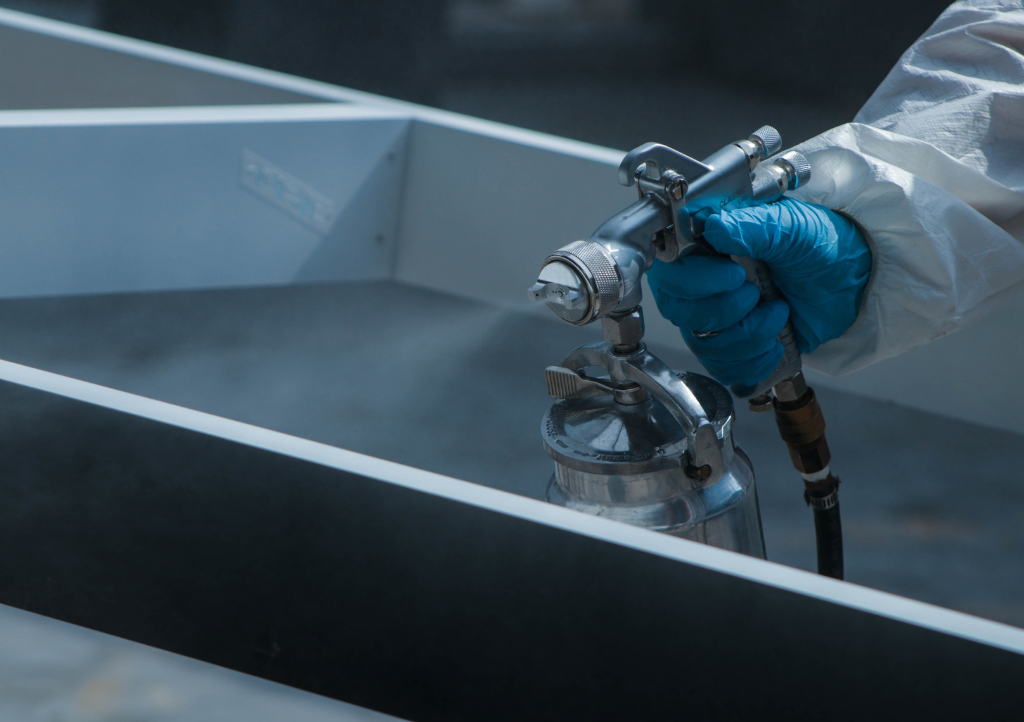
There are practical ways to reduce energy consumption in this area without disrupting production. High-efficiency HVLP spray guns, such as those in the Sagola range, reduce overspray and allow coatings to be applied more efficiently, meaning booths run for shorter periods to achieve the same output. UV-cured coatings cure in seconds under UV light rather than relying on heated airflow, dramatically reducing the energy required per unit.
Equipment condition also matters. Poorly maintained spray guns require more passes to achieve the same coverage, increasing both material use and booth run time.
Did You Know Waste Reduction Is More Impactful Than You Might Think?
In most finishing operations, wasted product is a hidden emissions source that rarely appears in sustainability calculations. Raw material production carries its own carbon cost, so every litre of lacquer discarded at the end of a shift represents not just a direct financial loss, but an embedded carbon cost that goes with it.
Products with longer pot life, a key characteristic of several Redwood products, allow manufacturers to use more of every batch they mix, reducing the volume of material that goes to waste. Consistent products that deliver predictable results also reduce the rework and respraying that add both material and energy costs.
Supply Chain Transparency Is Increasing
Another shift that is becoming more visible in 2026 is the growing expectation around supply chain sustainability. Large contract furniture buyers, housebuilders and retail customers are increasingly asking their suppliers to demonstrate measurable environmental credentials; not just policy statements.
This means that wood manufacturers supplying these sectors need to be able to account for the environmental impact of their finishing processes in a way they perhaps have not before. Sourcing materials from suppliers who hold recognised environmental accreditations, such as ISO 14001, is one way to start building that chain of evidence.
Redwood holds ISO 14001 accreditation and has committed to reducing its own emissions by at least 50% by 2030 as part of the SME Climate Commitment. That commitment passes demonstrable value through to customers in their own supply chain reporting.
Where Can You Start?
The manufacturers making the most progress toward net zero in their finishing operations are not those who have undertaken wholesale transformation overnight. They are the ones who have started with an honest review of where their biggest impacts lie, then made targeted changes.
A product audit from Redwood can establish a clear baseline; identifying which coatings in your current range carry the highest VOC loads, where product waste is highest and where equipment inefficiencies are adding unnecessary energy use. From there, changes can be introduced progressively, without disrupting production schedules.
For manufacturers who have not yet begun that review, the time to start is now. Regulatory requirements are tightening, customer expectations are rising and the products and equipment needed to make the transition are already available.
To discuss your finishing operation with the Redwood technical team, call us on 023 9223 3310 or email [email protected].